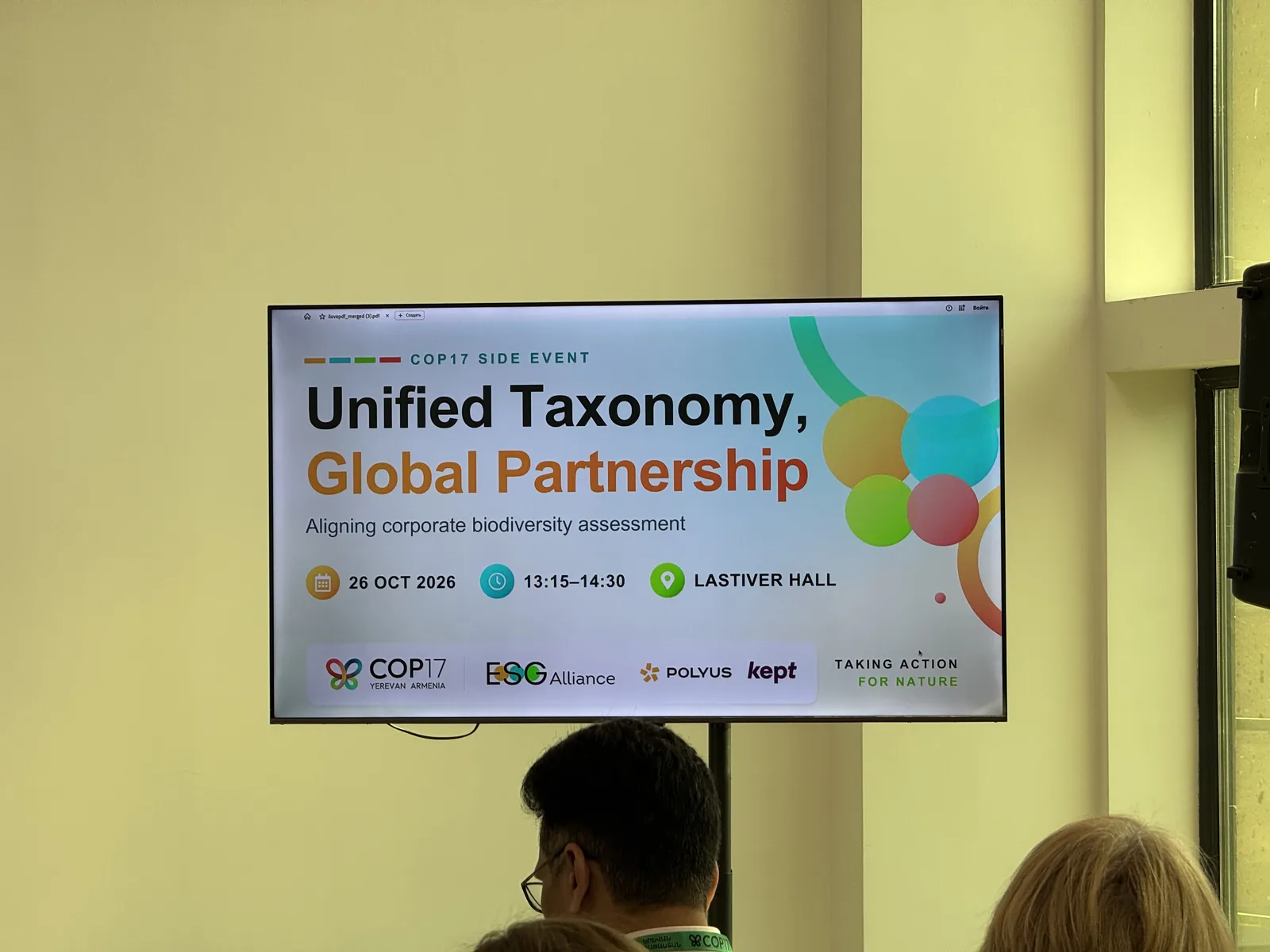
Day 8 · 26 October 2026
A shared language for corporate nature projects is a start; proving they work is the hard part
Highlights
What happened: At a COP17 side event, the National ESG Alliance, Polyus and Kept presented a business-led classification of corporate biodiversity projects and a companion method for scoring them, alongside views from China, India and Brazil.
Why it matters: The tools aim to let companies describe similar projects consistently, but speakers acknowledged that judging ecological effectiveness, and linking company results to national indicators, still needs work.
One project at the COP17 side event scored 98 out of 100. Maxim Polishchuk of Russian Railways described the company's support for the Talovsky lake and marsh complex near Lake Baikal, a 79.56-hectare site that Irkutsk Region designated a regional natural monument in 2024. The score came from a new assessment method that the organisers were still testing at COP17.
The number matters less than what surrounded it. The session's main point was that companies and governments need a common way to describe, classify and evaluate corporate biodiversity projects before those projects can be compared or counted towards national goals, and that the tools shown so far cover description better than proof of ecological results. This report covers the side event "One Taxonomy, Global Partnership: Aligning Corporate Biodiversity Assessment", held on 26 October 2026 from 13:15 to 14:30 Yerevan time in the Lastiver Room, COP17 Blue Zone, Yerevan. It was organised by the National ESG Alliance, Polyus and Kept.
A classification for company projects
Elena Groznaya, Deputy CEO of the National ESG Alliance, presented version 1.0 of the Alliance's classification of corporate biodiversity and ecosystem services projects. It has 9 classes, 32 groups and 120 coded project types. The largest class, species and habitat conservation, has 35 types. Each type comes with an indicative metric; code 3.3.6, covering artificial nesting, spawning and other breeding sites, counts the number of sites. Assessing ecological results, she noted, requires evidence suited to each project.
The classification calls for a scientifically supported positive contribution and safeguards against significant harm on and beyond the project site. The Alliance says it links directly to 10 of the 23 targets in the Kunming–Montreal Global Biodiversity Framework (KMGBF), including Target 3 on area-based conservation and Target 15 on business, and partially to 7 more. Target 15 asks governments to make large and transnational companies and financial institutions monitor, assess and disclose their biodiversity risks, dependencies and impacts. Ten companies had piloted the tool by June 2026, the Alliance reported.
The Alliance also reported overlap with the Multilateral Development Banks' Common Nature Finance Taxonomy. A published account says Russia's Ministry of Natural Resources and Environment endorsed the classification and used it in drafting the country's biodiversity strategy. That comes from the account, not from the session.
Scoring projects
Svetlana Sheynfeld of Kept presented a method for assessing biodiversity risks and project quality, performance and effectiveness. It compares a pre-project baseline, the current value and the planned target. Its risk assessment currently covers companies' own operations. A challenge raised in the session was how to connect company project results to national biodiversity indicators.
What companies and civil society reported
Company speakers described practical uses. SIBUR said a shared classification could help firms organise and compare initiatives across industries. Polyus reported classifying its projects and applying the assessment at existing sites and in planning for the Sukhoi Log gold project. En+ Group said it used the classification to review its portfolio and flag issues, such as noise mitigation and assessing impacts on nature.
A civil society panellist, according to the notes, mapped 205 publicly documented projects from 53 companies to about 400 code assignments. Governance and engagement, ecosystem conservation, and research and monitoring made up about two thirds of the assignments. The speaker stressed that evaluating conservation effectiveness would need further work.
Other routes to the same goal
Matt Jones of UNEP-WCMC, co-chair of the 2026 IPBES Business and Biodiversity Assessment, highlighted how companies depend on and affect biodiversity, and how they can influence suppliers, peers and policy. Ye Wang described China's approach: the People's Bank of China developed a trial Biodiversity Finance Catalogue in 2025, with pilots reported in 26 provinces and cities. Pravir Deshmukh of the Confederation of Indian Industry said about 160 companies engage with the India Business and Biodiversity Initiative, with investment activity involving around 800 wetlands; the notes say these figures could not be verified. Gustavo Cortes de Lima of Brazil spoke about cooperation among institutions, companies and universities.
Outcome
The notes record no decisions. Participants discussed which parts of national approaches could be compared across borders, and identified priorities: refining the classification, testing the tools across sectors and countries, improving measures of ecological effectiveness, and linking corporate reporting to national indicators. The Alliance said it wished to continue the dialogue with business initiatives and international partners.