Day 8 · 26 October 2026
COP17 freshwater session: why 30x30 for lakes starts with the catchment
Highlights
Speakers at a COP17 Presidency event argued that a lake's condition depends on its whole catchment, the land that drains into it, not just its shoreline.
The International Atomic Energy Agency (IAEA) launched the Global Network of Isotopes in Lakes (GNIL) to help countries collect comparable lake data and share it across borders.
Lake Sevan shows that restoring water levels cannot, alone, resolve nutrient pollution or warming, so monitoring must keep pace with the lake.
In brief
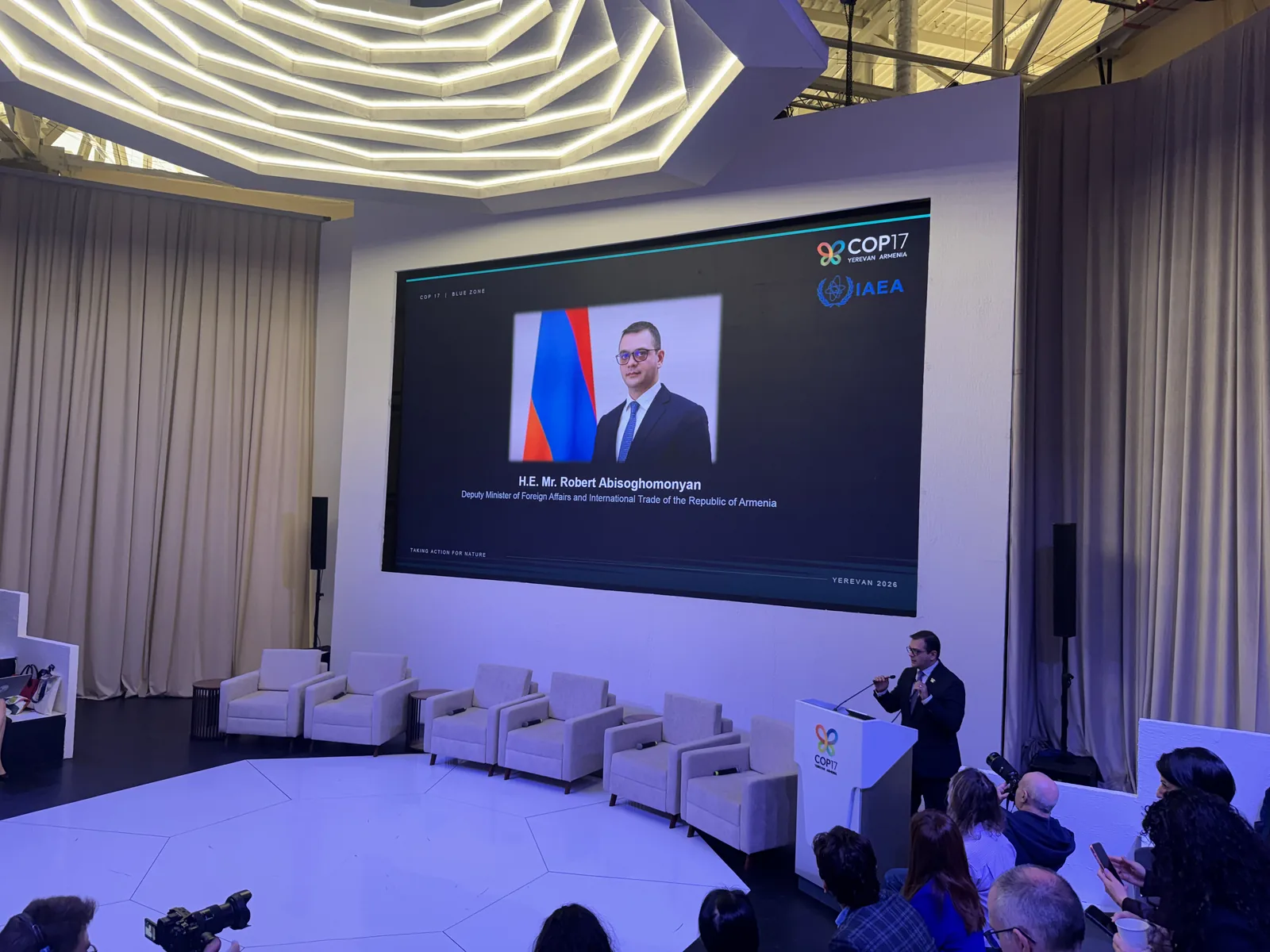
What happened. On 26 October 2026, Armenia's COP17 Presidency and the IAEA held a session at the Armenian Pavilion in Yerevan on science-based freshwater conservation. The IAEA launched GNIL there. It was a Presidency event, not a negotiated COP decision.
Why it matters. The Kunming–Montreal Global Biodiversity Framework (KMGBF) covers inland waters, yet the CBD's global assessment of progress on Targets 1–8, cited in the session summary, found restoration further advanced on land than in freshwater, coastal and marine ecosystems. The session's argument was that comparable, long-term data are what let countries decide where to act.
Lake Sevan's water level was artificially lowered by about 20 metres between 1933 and 2002, Gor Gevorgyan of Armenia's Scientific Center of Zoology and Hydroecology told the session. Armenia's recovery plan now calls for a rise of about 6 metres from the low-water baseline.
But Gevorgyan's point was that water level is only part of the problem. Restoring it cannot, on its own, resolve nutrient pollution or the effects of climate warming. That thread ran through the whole session, and it is this report's main argument: freshwater targets under 30x30 will be met only if countries understand and monitor the whole catchment, which takes comparable, long-term data.
A lake that shows the limits of one fix
Armenia's Deputy Minister of Foreign Affairs and International Trade, Robert Abisoghomonyan, opened the session by calling Lake Sevan a nationally important freshwater ecosystem and a restoration priority. He linked it to the Yerevan Declaration — Taking Action for Nature, adopted at the Leaders for Nature Summit on 16 October 2026, and called for stronger political commitment, scientific cooperation and reliable monitoring.
Gevorgyan supplied the detail. Nutrient pollution, meaning excess nitrogen and phosphorus that feed algal blooms, persists whatever the water level. Armenia plans to investigate how much comes from wastewater, agricultural runoff and lake sediments, including with German researchers. He added that stock assessments inform commercial fishing quotas, including for whitefish.
These were national plans described by a speaker, not decisions adopted at COP17.
Monitoring that keeps pace
Research sampling at deep-water sites in Small and Big Sevan has run monthly since 2018, Gevorgyan said, yet blooms and changes in dissolved oxygen can develop between visits. He called for higher-frequency monitoring, automated sensors, satellite observations and closer coordination among agencies and researchers. That was a recommendation: no funded sensor project was confirmed.
The same logic holds across borders. Liana Giorgadze, head of Georgia's Biodiversity Policy Department, said Georgia's shift to river-basin management raises the need for coordinated monitoring. Its Law on Water Resources Management, adopted in 2023, took effect in many provisions on 1 September 2026, with others due in 2027 and 2030. Georgia and Armenia signed a memorandum in 2025 on transboundary water monitoring in the Khrami–Debed river basin.
What isotopes add
Isotopes are forms of an element with slightly different atomic mass. In water, stable hydrogen and oxygen isotopes, such as deuterium and oxygen-18, act like fingerprints. IAEA isotope hydrologist Jhenelle Williams explained that they can help distinguish water sources, link surface water to groundwater and track the balance between inflow and evaporation. At Sevan, they could complement information on precipitation, rivers, groundwater and water moved through the Arpa–Sevan tunnel, helping managers see why a lake is changing and where to intervene.
GNIL extends two older IAEA networks: precipitation, developed with the World Meteorological Organization in the early 1960s, and rivers, initiated in 2002, said IAEA Deputy Director General Najat Mokhtar. Its initial phase will develop common protocols for coordinated sampling and data sharing. Mokhtar invited countries to take part and stressed laboratory capacity, training and sustained monitoring. The United Kingdom reported contributing £185,000 in two phases. At this stage GNIL is a framework, not yet a dataset.
From evidence to budgets
Other panellists focused on getting evidence into decisions. WWF's Christine Colvin urged researchers to work with communicators so findings reach the officials who control budgets. Her South African example: strategic water source areas cover roughly 10% of the country's land and generate about half its mean annual surface-water runoff. She called on governments to redirect harmful incentives towards freshwater conservation and noted gaps in reporting on inland waters. She also welcomed Armenia as the 55th country member of the Freshwater Challenge.
Professor Anjali Goswami, Defra's Chief Scientific Adviser, argued for involving scientists from the moment a problem is defined, backed by long-term monitoring budgets and reusable datasets. UNEP's Susan Gardner said poor water quality often originates upstream or beyond the shoreline, citing a Global Environment Facility-funded project in the Lake Tanganyika basin that combines fisheries co-management with landscape restoration. She called for training and technical assistance so national agencies and communities can use the evidence.
These are speakers' views, not negotiated outcomes.