Day 6 · 24 October 2026
Beyond "Recognition": Thailand's Open Government Plan and the Test of Community-Led Marine Management
Key takeaways
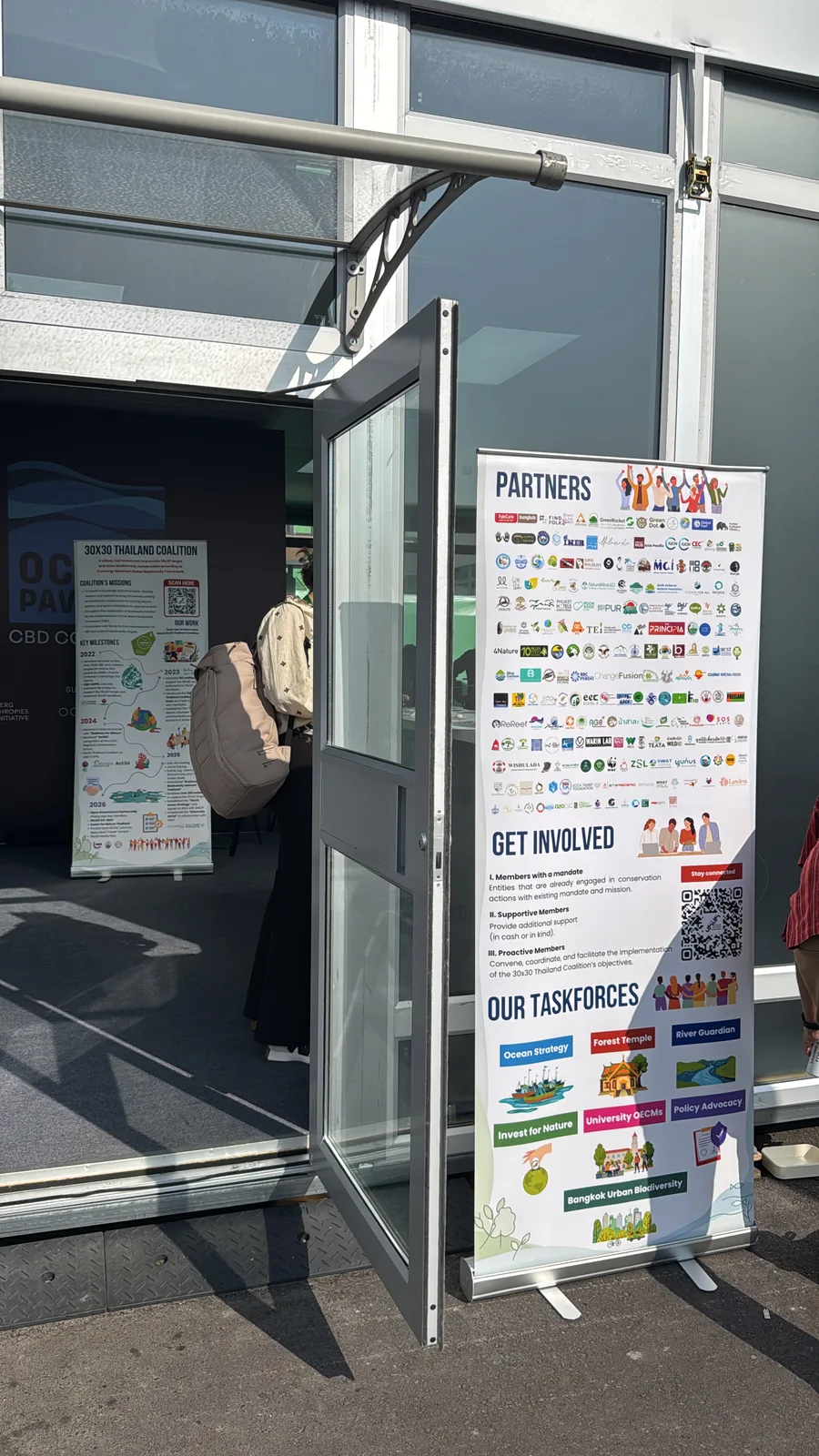
What happened: On 24 October 2026, the 30x30 Thailand Coalition, together with the ECCA Family Foundation and OCEAN5, hosted a side event at the Ocean Pavilion during CBD COP17. The event put Thailand's proposed open government commitment for Phang Nga Bay to the test.
Why it matters: The panel argued that declaring or recognising a locally managed marine area (LMMA) does not automatically lead to lasting conservation, because four structural obstacles remain.
The real test: Will the communities who look after these areas gain legal authority, a fair share of the benefits, and a way to hold government agencies to account?
On 2–3 April 2026, government officials, local leaders and civil society groups met in Krabi province to start drafting marine and coastal commitments under the Open Government Partnership (OGP). The Office of the Public Sector Development Commission (OPDC) reported that the workshop was held with the Department of Marine and Coastal Resources (DMCR) and the 30x30 Thailand Coalition. It covered participatory management, area-based tools such as LMMAs and other effective area-based conservation measures (OECMs), as well as finance and open data.
About six months later, the idea travelled to Yerevan, Armenia, for the 17th meeting of the Conference of the Parties to the Convention on Biological Diversity (CBD COP17). The side event took place at the Ocean Pavilion on Saturday 24 October 2026, from 13:00 to 14:15 Armenia time (16:00–17:15 Thailand time). Its title was "Open Government for 30x30: Beyond Announcement – Co-creating Effective, Equitable and Durable LMMAs in Thailand".
The event's central argument was that Thailand needs to go "beyond announcement". Declaring a community marine area is the easy part. The harder test is whether the communities who look after these areas will get legal authority, fair benefits, and a way to hold government agencies accountable.
Who was on stage, and what did they ask?
Thailand's coastal communities and small-scale fishers rely on marine ecosystems for their livelihoods, their food security and their resilience to climate change. Yet they still face competition over resources, fragmented data, limited management authority and a lack of long-term funding. The event therefore asked how LMMAs can go beyond declaration or recognition to deliver conservation that is effective, fair and lasting.
The 75-minute hybrid session opened with a short documentary, Sea Keepers, about community-led conservation in Lang Suan district, Chumphon province. Three online presentations followed:
Peechanit Ketsuwan, Director of the 30x30 Thailand Coalition, outlined four structural challenges (see the next section).
Sumit Ketsawaphithak, Director of the Regional and Local Administration Division at OPDC, explained how the OGP framework, built on transparency, participation and public accountability, can help address them.
Thipamat Upnoi, Director of the Marine and Coastal Resources Research and Development Institute at DMCR, presented DMCR's proposals under the OGP action plan.
A panel discussion followed, with Revadee Prasertcharoensuk of the Sustainable Development Foundation, Ketsiri Thotsaphonphaisan of Greenpeace Thailand, and Lina Salas of Turning Tides. It was moderated by Kittikun Saksung, Coordinator of the 30x30 Thailand Coalition.
Four obstacles that recognition can't fix
Peechanit noted that community-led marine management in Thailand is held back by governance problems as much as ecological ones:
Conflict between commercial and small-scale fisheries
Competing demands on both land and sea, including pressure from coastal development
Limited legal recognition and management authority for community charters
A lack of long-term funding for community conservation
Why an open government plan?
The OGP is a partnership in which member governments develop national action plans together with civil society. OPDC notes that members must follow a co-creation process. According to OPDC, Thailand's Cabinet approved its application to join on 2 December 2025, and the OGP announced Thailand's membership on 27 January 2026. On 2 February, DMCR and OPDC met to align the marine work with the Cabinet resolution and OGP principles.
The framework fits the problem because transparency, participation and public accountability all come down to who holds power, who benefits, and who can be held to account. A conservation declaration on its own does not answer those questions.
What DMCR is proposing for Phang Nga Bay
The project's concept paper covers Phang Nga Bay, which links Phang Nga, Phuket and Krabi provinces. It sets out five connected approaches. All of them are proposals, and the paper states that they still need discussion and confirmation from the responsible agencies.
An open government data platform for sharing marine and coastal data
Marine spatial planning (MSP), a participatory way of mapping marine areas and resolving conflicts over how the sea is used
LMMAs, to strengthen community participation, management roles and recognition
Sustainable finance, including payments for ecosystem services (PES), where those who benefit pay to maintain the ecosystem
An evaluation system to track marine health, governance performance and environmental justice
Recognition is not protection
The panel stressed the difference between two policy statuses. An ecologically or biologically significant marine area (EBSA) does not automatically receive legal protection, and recognising an LMMA does not automatically make it an OECM.
Panellists also drew a line between community benefit-sharing, meaning conservation and livelihood outcomes, and access and benefit-sharing for marine genetic resources.
The discussion focused on three questions:
What should Thailand's marine and coastal OGP commitment prioritise?
How can communities gain management authority, rights and a fair share of benefits beyond formal recognition?
What role can policy, technical and financial partners play in supporting LMMAs and OECMs, including in tackling problems that originate outside the areas communities look after?
What comes next
The session closed with questions and comments from participants. It then summarised key recommendations on community rights, inclusive governance and long-term sustainability, which will feed into Thailand's marine and coastal OGP commitment.
Two things are worth watching. The first is whether DMCR's five proposals are confirmed by the responsible agencies and become commitments in Thailand's OGP action plan. The second is whether those commitments include legal rights for communities.
Our thanks go to our co-organisers, the ECCA Family Foundation and OCEAN5, as well as DMCR, the Office of the Public Sector Development Commission (OPDC), the Sustainable Development Foundation, Greenpeace Thailand, Turning Tides, and all the speakers and the moderator.