Day 5 · 23 October 2026
Snow leopard villages show that coexistence depends on who decides and who benefits, not only on corrals and insurance
Highlights
What happened: On the International Day of the Snow Leopard, 23 October, organisers presented four policy advisories at COP17 to help countries put coexistence, sustainable economies, valuation and community monitoring into their national biodiversity plans.
Why it matters: The session's coexistence specialist said technical measures can cut immediate losses, but lasting progress depends on who makes decisions, who has access to resources and how benefits are shared.
When a snow leopard died near Kibber, a village in India's Spiti Valley, residents brought white ceremonial scarves called khataks to pay their respects, and the animal was cremated. That is the account of field coordinator Kalzang Gurmet, published in March 2017. Research also documented a retaliatory killing of a snow leopard in the same village in the 1990s.
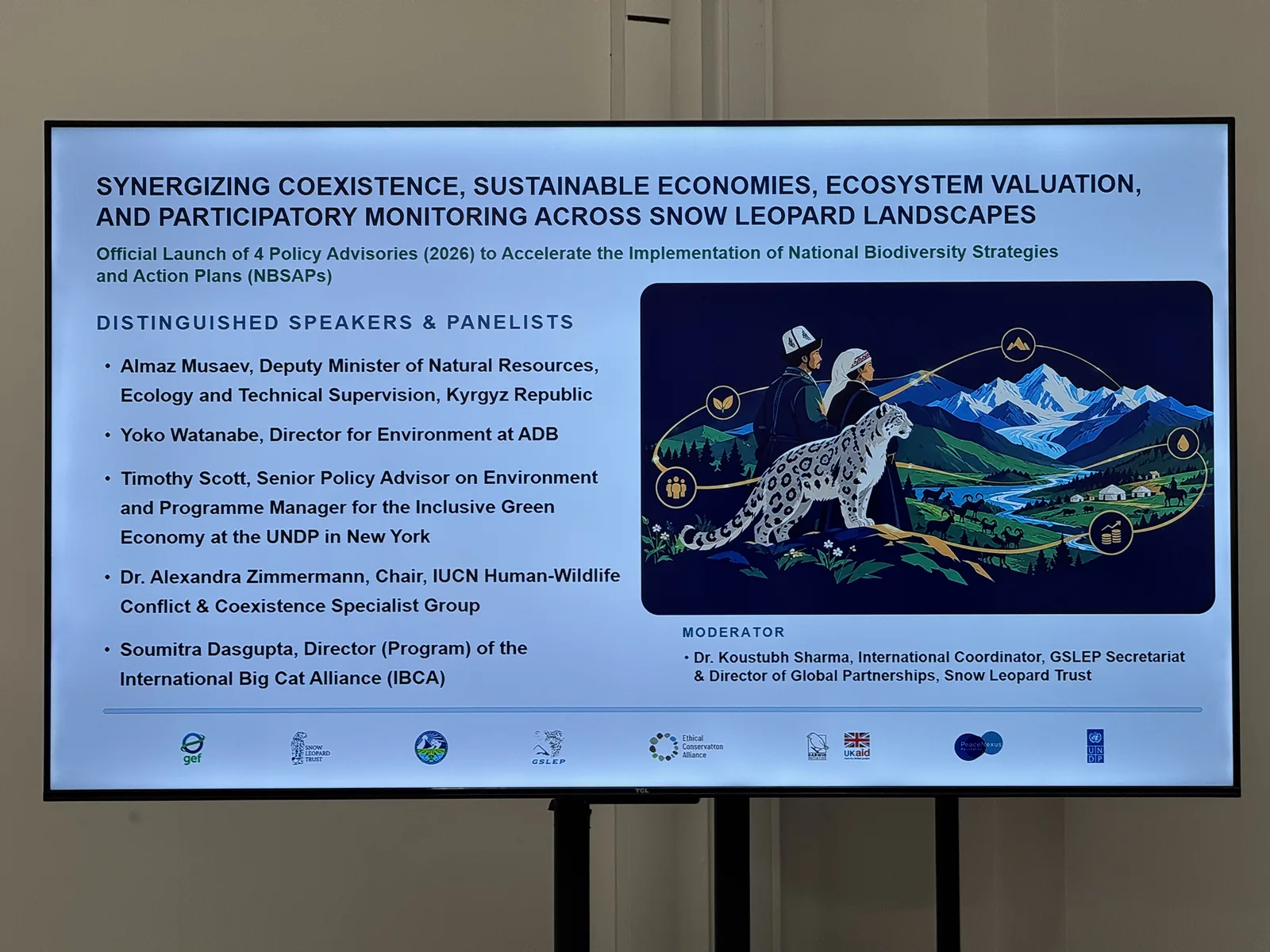
The shift between those two moments set the argument of a COP17 side event: coexistence with wildlife is built through insurance, herding, income and, above all, local decision-making, not by technical fixes alone. The session, "Synergizing Coexistence, Sustainable Economies, Ecosystem Valuation, and Participatory Monitoring Across Snow Leopard Landscapes", was held on Friday 23 October 2026 from 15:00 to 16:30 in Spitak, Side-event Room 2, in the Blue Zone at COP17 in Yerevan, Armenia. The Snow Leopard Trust, Kyrgyzstan's Ministry of Natural Resources, Ecology and Technical Supervision, the Global Snow Leopard and Ecosystem Protection Program (GSLEP) and the Ethical Conservation Alliance organised it. The date coincided with the International Day of the Snow Leopard, set by a UN General Assembly resolution of 12 December 2024.
What changed in Kibber
According to the opening speaker, the change in attitudes followed years of collaboration involving livestock insurance, better herding practices, predator-resistant corrals and conservation education. Snow leopard tourism added income, and Kibber and neighbouring Chicham negotiated a common visitor fee after a dispute over tourism. Eleven women from Kibber helped operate camera traps and analyse images for Himachal Pradesh's 2025 snow leopard and prey assessment.
Four policy advisories
The organisers presented four advisories to help countries implement their national biodiversity strategies and action plans (NBSAPs), the plans each country prepares under the Kunming–Montreal Global Biodiversity Framework (KMGBF). They are proposals, not agreed decisions.
No. 13, sustainable economies: a revised 2022 advisory proposing three or four landscape zones based on biodiversity, ecosystem services, land tenure and existing uses, plus community enterprises that share benefits equitably. The organisers link it to Targets 9 and 10.
No. 15, wildlife-caused damage: separate direct damage, such as livestock losses, from disagreements among people over how to respond, and combine measures such as livestock protection and community-managed insurance. Target 4.
No. 16, valuation: use ecological, economic and sociocultural evidence, including Indigenous and local knowledge, to make nature's values visible in planning and investment. Target 14.
No. 17, participatory monitoring: involve Indigenous Peoples and local communities in choosing indicators, collecting and interpreting data, and respect Indigenous data sovereignty. Targets 21 and 22.
What the partners said
Yoko Watanabe of the Asian Development Bank (ADB) spoke about working across landscapes and borders and involving finance and planning ministries. ADB estimates that sectors moderately or highly dependent on nature account for about 75% of Asia-Pacific GDP. Its Glaciers to Farms adaptation initiative spans nine countries, and the Green Climate Fund approved US3.5 billion financing envelope.
Soumitra Dasgupta of the International Big Cat Alliance (IBCA), launched in 2023 to support seven big cat species, discussed cooperation with GSLEP and India's participatory forest management. A UNDP representative linked the advisories to NBSAP finance, noting that a GEF-funded programme supports 139 countries with plan updates and reporting.
The coexistence specialist, who is not named in the notes, made the point that gave the session its argument: technical measures can reduce immediate losses, but lasting progress depends on who makes decisions, who has access to resources and how benefits are shared. This discussion related to Target 4 of the framework, which calls for managing human–wildlife interactions to minimise conflict and support coexistence. The notes record discussion of possible ADB project approaches and interest in further IBCA–GSLEP cooperation, but no formal decisions or deadlines.