Day 4 · 22 October 2026
Coastal communities already manage the sea. Making it count for 30x30 depends on law, money and consent
Highlights
What happened: At a COP17 side event on 22 October, speakers from the Philippines, Indonesia, Ghana and Mozambique described coastal communities already managing fisheries, and asked governments to back them with legal mandates and funding.
Why it matters: Ghana extended its inshore exclusion zone, which bars industrial vessels, from 6 to 12 nautical miles in 2025, showing how a legal change can protect community fishing grounds.
When Ghana's fishers wanted stronger protection for their fishing grounds, they organised at landing beaches, worked with traditional leaders, used radio and petitioned decision-makers. Ghana's Fisheries and Aquaculture Act, 2025 (Act 1146) now extends its Inshore Exclusion Zone from 6 to 12 nautical miles. That is a legal result, and it came from fishers.
It points to the main argument of a COP17 side event on 22 October: coastal communities already do much of the work of managing the sea, and Target 3 of the Kunming–Montreal Global Biodiversity Framework (KMGBF), the 30x30 target, can only count that work if law, money and consent catch up.
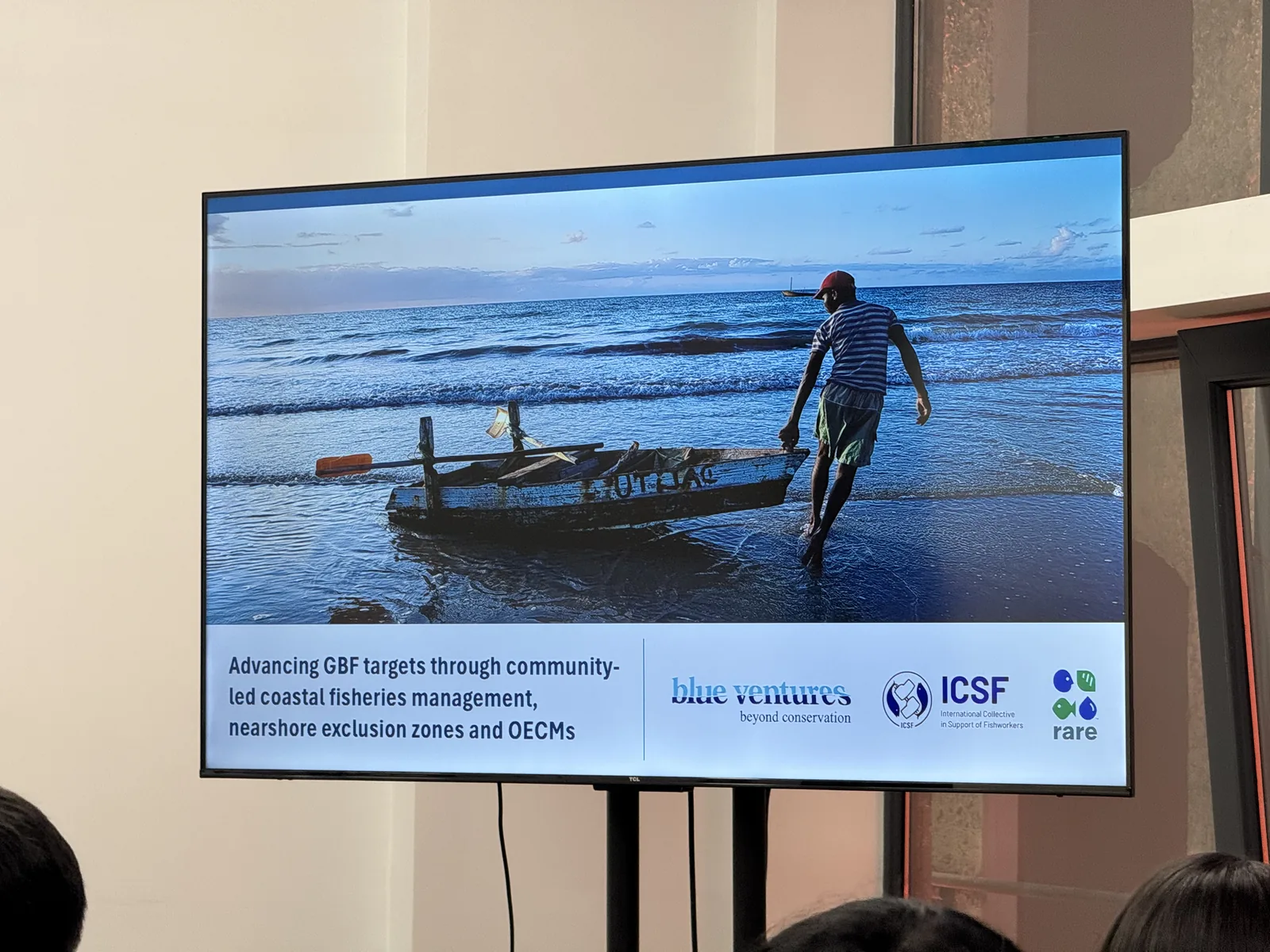
The session, "Advancing 30×30 through community-led coastal fisheries management, nearshore exclusion zones, and OECMs", ran from 18:15 to 19:35 on Thursday 22 October 2026 in Talin, Side-event Room 1, in the Blue Zone in Yerevan. Rare, Blue Ventures and the International Collective in Support of Fishworkers (ICSF) co-hosted it, and Rocky Sanchez Tirona of Rare moderated.
What the target asks for
The marine part of Target 3 calls for at least 30% of coastal and marine areas to be effectively conserved and managed by 2030. It covers protected areas and other effective area-based conservation measures (OECMs), meaning areas outside formal protected areas that are managed in ways that deliver lasting conservation. The target also asks that these systems be equitably governed and recognise Indigenous and traditional territories where applicable.
What communities are already doing
Miriam Petalcorin, president of the women's fisheries organisation HAYUMADORA in the Philippines, described a gender-responsive planning process that brought women into the technical working group and gave them a role in designing local programmes.
Michael Thungari, Regent of the Sangihe Islands in North Sulawesi, Indonesia, described customary seasonal closures and community-managed access areas that complement formal conservation. The notes give two sites: the 164,251.94 ha Tatoareng Islands conservation area, designated in 2019 and managed by North Sulawesi Province, and the separate Manganitu Selatan–Mahumu managed-access initiative, which spans 9,504 ha across nine villages and includes a 260 ha no-take area. Thungari also discussed a preliminary assessment of areas that could qualify as OECMs. Recognition, the notes say, would need evidence of sustained outcomes and the support of rights holders.
Simon Okoe Kwao of the Canoe and Fishing Gear Owners Association of Ghana described the campaign behind the 12-nautical-mile zone. The Act bars industrial vessels from it and provides a legal basis for fisheries co-management. He asked for clear enforcement responsibilities, funding for co-management and representation for chief fishermen, canoe owners, crew, processors and traders.
What governments said
These were speakers' accounts, not decisions.
Ahmad Sofiullah of Indonesia's Ministry of Marine Affairs and Fisheries outlined the country's goal to conserve 30% of its waters, about 97.5 million ha, by 2045. He reported about 30.98 million ha in marine conservation areas in 2025 and about 9.76 million ha of candidate OECMs, still subject to assessment.
Pejul Calenga of Mozambique's national conservation agency, ANAC, said community fisheries councils take part in fisheries management. Mozambique's COP17 statement reported marine protected areas covering 4.68% of its marine area, with an aim of at least 12% by 2030. A draft strategy proposes a network of protected areas and OECMs covering at least 30% of its exclusive economic zone by 2035.
Alfredo Coro II, Mayor of Del Carmen on Siargao Island, called for direct, multi-year financing that local governments can use for monitoring, management and enforcement, and for local work to appear in national reporting. A Philippine environment official's estimate, reported by Rare, put locally managed marine protected areas at about 1,800 covering about 3.1 million ha, with 10–15% estimated to be effectively managed.
Who decides on recognition?
In his closing reflections, Olivier Chassot of IUCN Asia said rights holders should decide whether to seek OECM recognition. That framing matters: recognition is something communities opt into, not something agencies impose on them.
Across the discussion, speakers asked for clear legal mandates, a meaningful role for fishers and customary authorities, direct and sustained financing, and support for monitoring and enforcement. Rare's public recap records no formal decisions or assigned actions.