Day 1 · 19 October 2026
Deep Blue Financing the Future of Ocean Conservation
Highlights
What happened: At COP17 in Yerevan, Levoca, ORRAA and Rare presented DEEP BLUE, a proposed facility seeking $100 million in grant contributions for 7 to 10 outcomes-based ocean finance transactions.
Why it matters: The ocean needs about $175 billion a year but receives about $25.5 billion, according to the session notes, and DEEP BLUE would release money only when independent verifiers confirm agreed results.
What it means for Thailand: Phase 2 of its Indonesian proof of concept explicitly supports the fisheries ministry's 30x30 targets, so the open question is whether a similar model could back coastal commitments elsewhere in Southeast Asia.
DEEP BLUE proposes to pay for ocean results, not activities. Investors put up the money first, and funders pay only after an independent verifier confirms that agreed outcomes have been achieved.
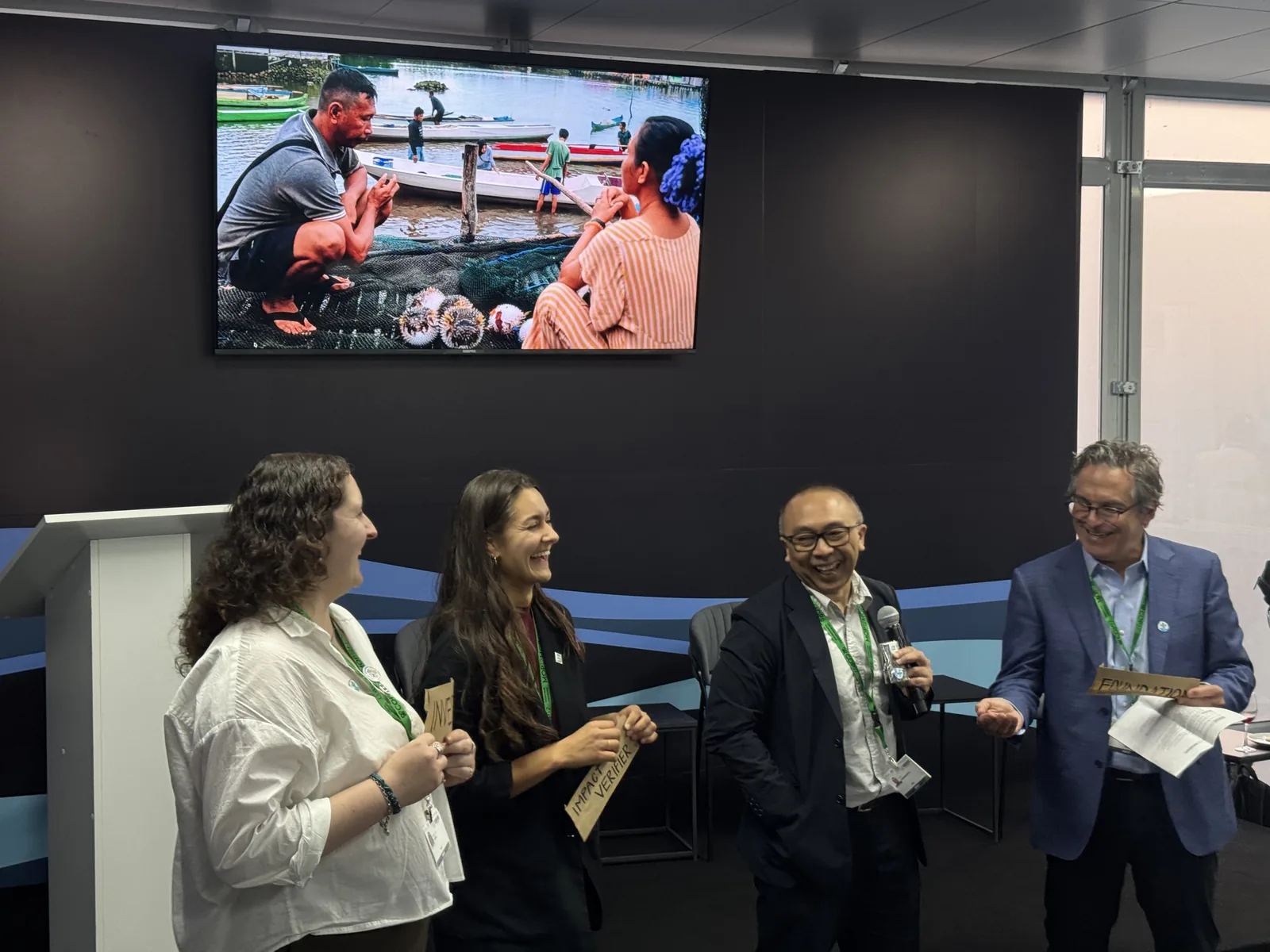
The facility was presented in the session "DEEP BLUE is a new outcomes purchasing and financing facility for the regenerative and sustainable blue economy, led by Levoca, ORRAA and Rare", on Day 1 of COP17 (19 October 2026) at The Ocean pavilion.
The central point is that the idea is only as strong as the measurable outcomes it can buy. For 30x30, that makes clear, verifiable targets the real test.
The problem DEEP BLUE targets
The session notes give three reasons. First, the funding gap is large: the ocean needs about $175 billion a year, receives about $25.5 billion and so faces a shortfall of roughly $149.5 billion. SDG 14, the global goal on life below water, gets less than 1% of SDG financing.
Second, how money is spent matters as well as how much. Conservation benefits are spread across many beneficiaries, so no single payer exists, and projects struggle to turn those benefits into revenue.
Third, the notes describe a market gap. Outcomes-based finance has deployed over $120 billion in sectors such as health and education, but no dedicated platform exists for the blue economy.
How the facility would work
Private investors and development finance institutions (DFIs) would provide upfront capital to implementers. Projects such as fisheries, mangroves, reefs and seagrass would deliver measurable outcomes. An independent verifier would check results against pre-agreed metrics, and DEEP BLUE would release outcome payments that repay investors on agreed terms.
Rare would host the programme, Levoca would manage the platform technically, and ORRAA would lead learning and convening.
The $100 million would be grant funding, not a return-seeking fund, and contributors would receive no financial return. Project-level investors may be repaid under separate documents. Contributions would be paid over up to three years, with outcome payments running through 2033.
| Allocation | Amount | Share |
|---|---|---|
| Outcome funding | $88.0M | 88% |
| Technical assistance | $5.1M | 5.1% |
| Platform operations | $6.1M | 6.1% |
| Programme reserve | $0.8M | 0.8% |
What the proof of concept shows
The Indonesia Small-Scale Fisheries Impact Bond, launched in 2025, is the working example. According to the notes, it secured $6 million in outcome funding across three sites in Southeast Sulawesi, with payments tied to fish biomass, benthic cover (the plants, corals and animals covering the seabed) and area protected. Rare announced the $6 million raise in 2024.
Phase 2 would expand to three new provinces and add blue carbon and marine protected area management. The notes say it explicitly supports Indonesia's fisheries ministry in meeting its 30x30 targets.
Pipeline, safeguards and limits
The facility has identified 16 opportunities: nine in ocean conservation, four in fisheries, two in circular economy and blue technology, and one in ridge-to-reef work. East Asia and Pacific leads with seven deals, followed by Latin America and the Caribbean with four. Three are profiled: Indonesia's Phase 2, Maré Viva Pará in Brazil (mangroves) and Tumaco Resiliente in Colombia (ridge to reef). Priority geographies are countries eligible for official development assistance (ODA) and small island developing states.
On safeguards, the platform applies IFC-aligned environmental and social standards, gender integration and free, prior and informed consent (FPIC) from affected communities. Deals that cannot show credible FPIC compliance will not proceed to contracting. Verification is independent of platform management.
The limits are stated in the notes. The final legal form and jurisdiction are under review, and terms are indicative only. Pipeline details are available only to qualified funders under a confidentiality agreement. The memo itself says outcomes-based finance is not a universal solution; it suits cases where outcomes are measurable, costs are proportionate and payment commitments are credible.
The vision goes well beyond the pilot. The short-term goal is $100 million, 7 to 10 transactions, more than 150,000 hectares under regenerative management and three to five ODA-eligible countries. By 2035, the facility aims for $10 billion a year as shared verification infrastructure for ocean finance. That is an ambition, not a commitment.