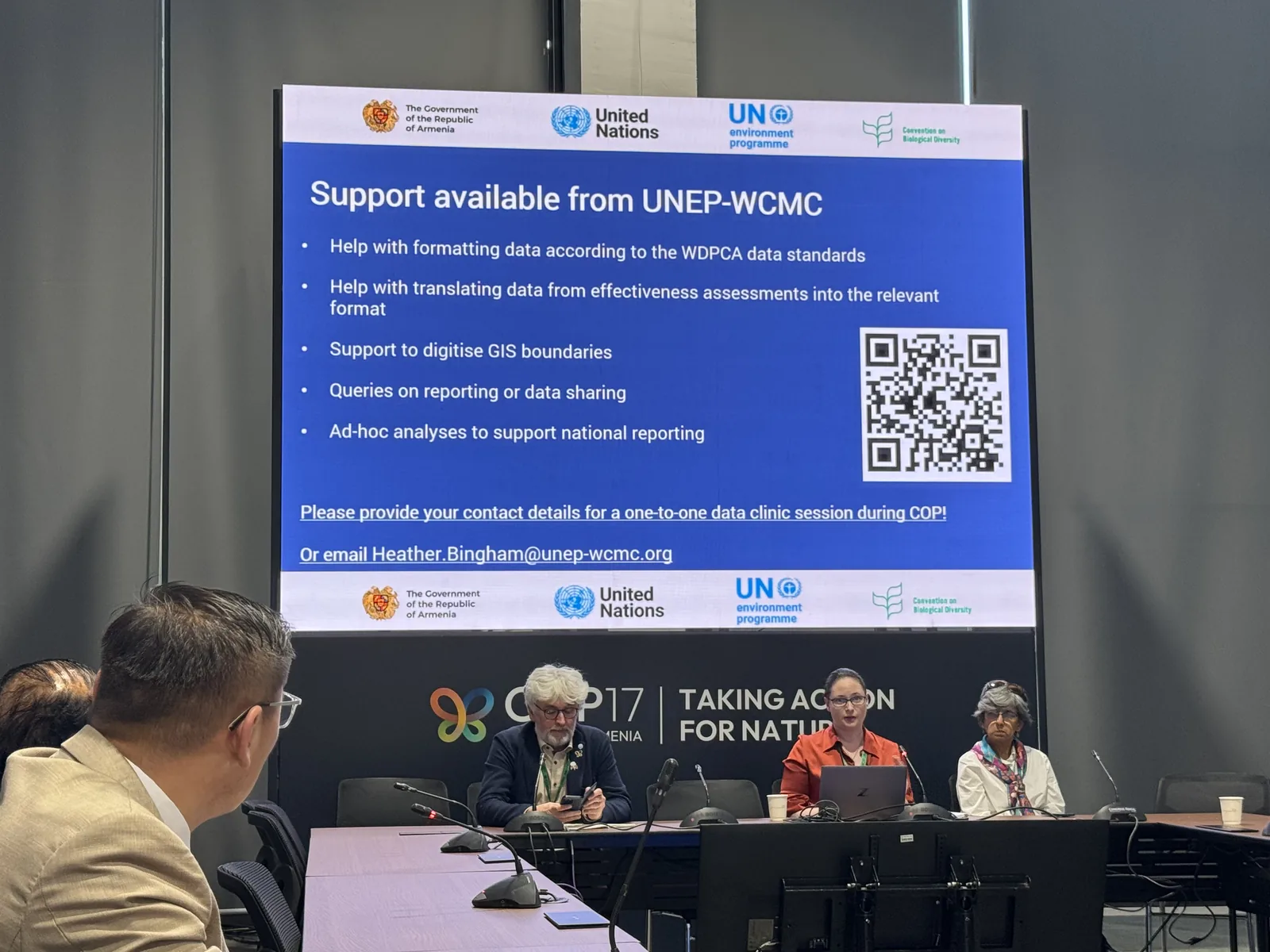
Day 1 · 19 October 2026
Preparing for the Protected Planet Report 2027
COP17 briefing on global progress towards Target 3
19 October 2026 | 13:15–14:45 Yerevan time | Blue Zone, CBD COP17
Speakers: Neville Ash (UNEP-WCMC, opening), Heather Bingham (UNEP-WCMC), Madhu Rao (IUCN World Commission on Protected Areas) and Tim Badman (IUCN). UNEP COP17 programme
Highlights
What happened: At a COP17 briefing in Yerevan on 19 October, UNEP-WCMC and IUCN told Parties that updated protected area and OECM data must reach UNEP-WCMC by 30 November 2026 to inform the Protected Planet Report 2027.
Why it matters: Under the CBD's call for data, geospatial data submitted after the deadline will be left out of the report that assesses global progress on Target 3.
The most useful number at a COP17 briefing on 19 October was not a percentage. It was a date: 30 November 2026.
That is the deadline for countries to send updated data on protected areas and "other effective area-based conservation measures" (OECMs) to UNEP-WCMC, the UN Environment Programme's biodiversity assessment centre. The data will shape the Protected Planet Report 2027, the next global check on Target 3 of the Kunming–Montreal Global Biodiversity Framework (KMGBF), the 30x30 commitment. The central point is simple. Global 30x30 progress is measured from records that governments submit, so a site that exists on the ground but is missing from the database cannot be counted.
Counting more than coverage
Target 3 calls for at least 30% of land, inland waters and sea to be conserved by 2030. It also asks that areas be effectively managed, equitably governed, ecologically representative and well connected. It recognises Indigenous and traditional territories where applicable and calls for respect for the rights of Indigenous Peoples and local communities.
Headline indicator 3.1 tracks coverage by protected areas and OECMs, which are areas outside formal protected areas that still deliver lasting conservation. Its global data come from the World Database on Protected and Conserved Areas (WDPCA).
The 2024 Protected Planet Report found that 32% of Key Biodiversity Areas, sites of global importance for nature, lay entirely outside protected and conserved areas. It also found that many ecoregions were under-represented and that evidence on management effectiveness and equitable governance was limited. The 2027 report, according to the session notes, will assess all elements of Target 3 using globally comparable data, including site boundaries for spatial analysis.
A database that changes every month
Protected Planet is a joint UNEP and IUCN initiative managed by UNEP-WCMC. Governments are the main contributors to the WDPCA, and the database is updated monthly.
Two recent releases show how the figures move. The October release is the COP17 snapshot; November is the latest available as of 16 November.
| Release | Realm | Combined coverage | Protected areas | OECMs |
|---|---|---|---|---|
| October 2026 | Land and inland waters | 18.69% | 489,023 | 7,510 |
| October 2026 | Marine | 10.04% | 17,227 | 239 |
| November 2026 | Land and inland waters | 18.66% | 471,215 | 8,575 |
| November 2026 | Marine | 9.99% | 17,432 | 265 |
Land and inland-water coverage edged down by 0.03 percentage points and marine coverage by 0.05, while the number of recorded OECMs rose in both realms. The session notes do not explain these changes. My reading is cautious: they remind us that the figures are a snapshot of the records held at a given moment, not a fixed score.
What Parties are asked to send
CBD Notification 2026-066, issued on 3 September, asks Parties to send updates to pca@unep-wcmc.org by 30 November. Submissions should include spatial data and site attributes for protected areas and recognised OECMs, plus the applicable Data Contributor Agreement. Management-effectiveness data, which show how well sites are run, go through separate reporting guidance.
Parties with incomplete datasets can prioritise the spatial updates they have ready. The notification states that geospatial data submitted after the deadline will not be included in the report. The report will still describe discrepancies between national reports and the WDPCA, and Parties can keep submitting for ongoing monitoring through Protected Planet.
The session notes identify the IUCN World Protected and Conserved Areas Congress as the planned launch venue. IUCN has confirmed the Congress for 4–10 September 2027 in Panama City.
Help is available, including after COP17
Speakers described support on offer, as recorded in the session notes. Heather Bingham of UNEP-WCMC outlined help with data formatting, digitising GIS boundaries and preparing management-effectiveness results.
Madhu Rao of the IUCN World Commission on Protected Areas said its specialists can help compile data, apply IUCN management categories, work through OECM criteria and resolve overlapping designations. Tim Badman of IUCN encouraged Parties to report available evidence on management effectiveness, governance and equity.
Two later launches add tools. On 20 October IUCN released Version 2.0 of the Global Standard for Effective and Equitable Protected and Conserved Areas, previously the Green List Standard. On 28 October Armenia's COP17 Presidency, the CBD Secretariat, FAO and IUCN launched the Yerevan Global OECM Action Hub to support identifying, recognising and reporting OECMs.