Day 10 · 28 October 2026
High seas squid shows why catch limits, crew protection and traceability have to be fixed together
Highlights
What happened: The Environmental Justice Foundation (EJF) hosted a side event and documentary screening at COP17's Ocean Pavilion on squid fisheries in the Southwest Atlantic and Southeast Pacific.
Why it matters: EJF's satellite analysis found an average of 343 squid jigging vessels a year just beyond Argentina's waters between 2019 and 2024, with estimated fishing hours up 65%.
At a point in the South Atlantic known as "Mile 201", just beyond Argentina's exclusive economic zone, EJF identified an average of 343 squid jigging vessels a year between 2019 and 2024. Fishing hours rose an estimated 65% over that period. Chinese-flagged vessels accounted for 91% of estimated effort. In 2024, EJF estimated that effort on the adjacent high seas was more than four times the effort inside Argentina's zone.
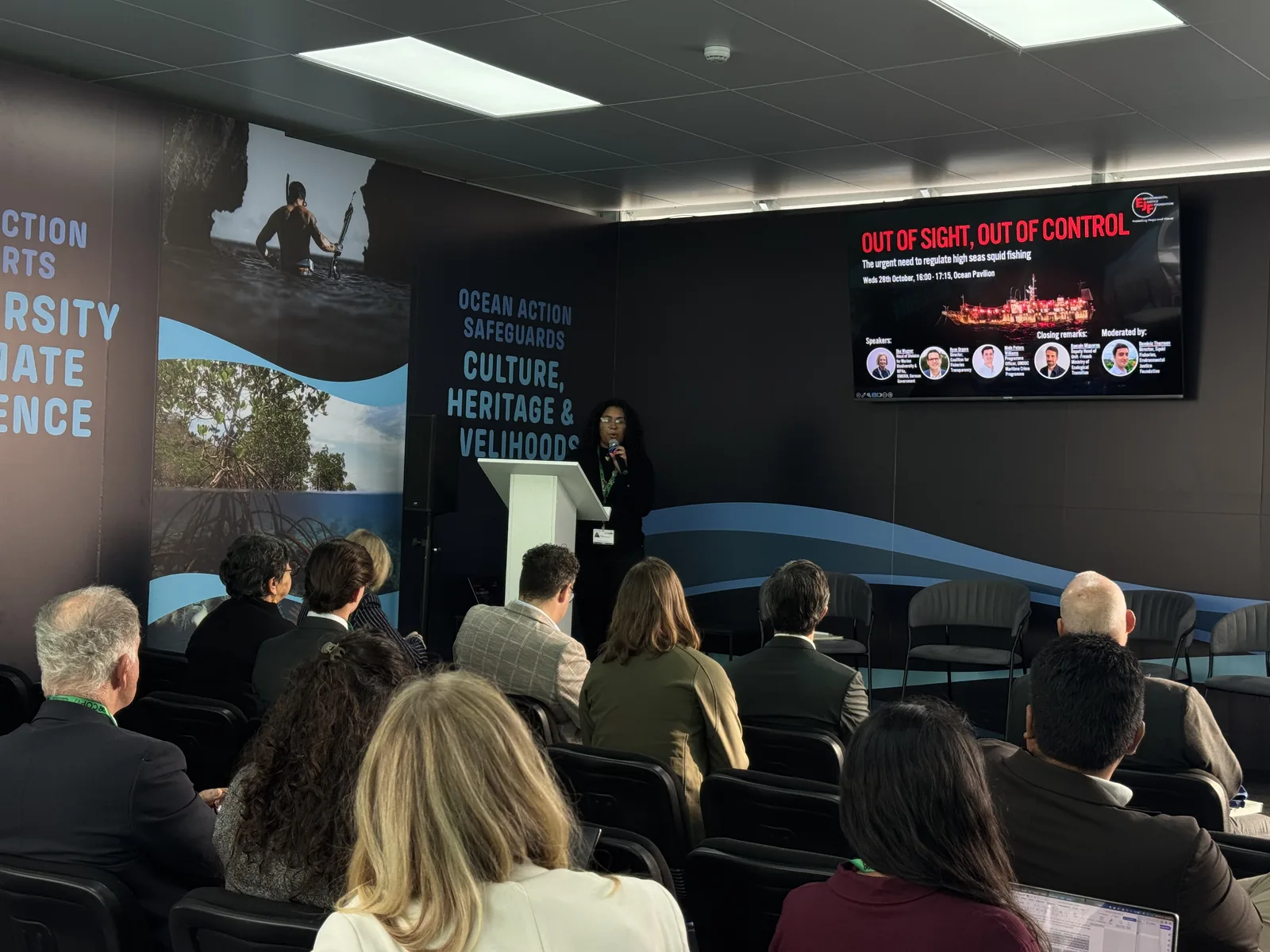
The side event, "Out of Sight, Out of Control: The urgent need to regulate high seas squid fishing", took place at the Ocean Pavilion during CBD COP17 in Yerevan on 28 October 2026. This article draws on the event briefing, which summarises two EJF investigations; it contains no remarks from the room. The central argument is that three outcomes have to be pursued together: adjusting fishing pressure when abundance falls, protecting workers on long voyages and tracing catches to the vessels that made them.
Two fisheries, one pattern
In the Southwest Atlantic, distant-water fleets target Argentine shortfin squid (Illex argentinus) as it moves between Argentina's waters and the high seas. In the Southeast Pacific, they target jumbo flying squid (Dosidicus gigas), which supports artisanal fisheries and food webs along western South America. EJF found hundreds of vessels operating in both regions.
That overlap matters because a vessel can change grounds or ports while its ownership, crew conditions and compliance history stay hard for authorities and buyers to verify. Argentina manages its own waters with licensing, monitoring, surveys and seasonal closures, but these are less effective when much of the catch comes from beyond its reach.
What the stock evidence shows, and what it does not
In the Southeast Pacific, EJF reported that the number of Chinese vessels in its study area doubled between 2014 and 2024. A Chinese assessment submitted to the South Pacific Regional Fisheries Management Organisation (SPRFMO) put jumbo squid catch per vessel-day at 8 tonnes in 2015 and 2.4 tonnes in 2024, and a Chilean assessment also pointed to declining catch rates. EJF found that the SPRFMO measures it reviewed lacked catch limits for jumbo squid and adequate safeguards for vulnerable wildlife.
The briefing is candid about uncertainty. Satellite tracking misses vessels that switch off their transmitters, reported landings can omit catches, and catch rates shift with ocean conditions. For Argentine shortfin squid, the Atlantic report cites a Food and Agriculture Organization assessment that classified it as fished at biologically sustainable levels, alongside a separate assessment that found signs of overfishing in one stock component. Both species are short-lived and fluctuate sharply, so a poor breeding season combined with heavy fishing could leave too few squid to reproduce. EJF's case is for precaution, not for a proven collapse.
Crew conditions and wildlife are part of the same problem
The Southwest Atlantic investigation drew on interviews with 169 crew members from 110 vessels. EJF linked 29 of the 46 Chinese-flagged vessels covered by those interviews to reports of physical violence or a worker death. In the Southeast Pacific, EJF interviewed 81 Indonesian and Filipino fishers who had worked on 60 Chinese-flagged vessels, and about half reported experiencing or witnessing physical abuse. They also described withheld pay, confiscated identity documents and recruitment debt. The samples had uneven coverage across fleets, so these figures describe the vessels studied, not the whole industry.
Crew also reported shark finning on about 60% of the 60 vessels in the Pacific sample and the deliberate capture of marine mammals on about a third. These are allegations reported by EJF.
Trans-shipment blurs the chain
Trans-shipment, in which vessels pass catch to refrigerated cargo ships at sea, lets them keep fishing without returning to port. When catches are mixed in transport or processing, buyers can lose track of which vessel caught a shipment. EJF traced routes through processing hubs such as Zhoushan, China, and identified potential links to buyers in the United States, the European Union, the United Kingdom and other markets, though broad trade categories and incomplete records limited verification.
Ports matter too. After Peru tightened monitoring for foreign squid vessels, EJF reported a shift towards Chilean ports. Of 163 Chinese-flagged squid vessels it tracked using Chilean ports in 2025, it linked nine to its investigations of alleged fisheries or labour abuses.
What EJF recommends
For the Southwest Atlantic, EJF calls for coastal and fishing states to establish a regional arrangement for the high seas squid fishery. For the Southeast Pacific, it calls on SPRFMO members to strengthen the existing framework with catch limits, wildlife safeguards, more observers and enforceable crew standards. Across both regions it urges flag states to disclose who owns and controls vessels, port states to share inspection findings, and importing countries and buyers to require records tracing squid to species, vessel and fishing area. For 30x30, the briefing says high seas marine protected areas and environmental impact assessments under the BBNJ Agreement can complement fisheries management. These are EJF's recommendations, not decisions.