Day 9 · 27 October 2026
The first high seas marine protected areas will depend on cooperation that starts before the proposal is written
Highlights
What happened: A COP17 side event brought together governments, regional bodies, researchers and funders to discuss how to build the first connected network of high seas marine protected areas under the BBNJ Agreement.
Why it matters: Protected Planet's November 2026 update puts global marine coverage at 9.71% for protected areas and 9.99% with other effective area-based measures, leaving a gap to 30% of roughly 72 million km².
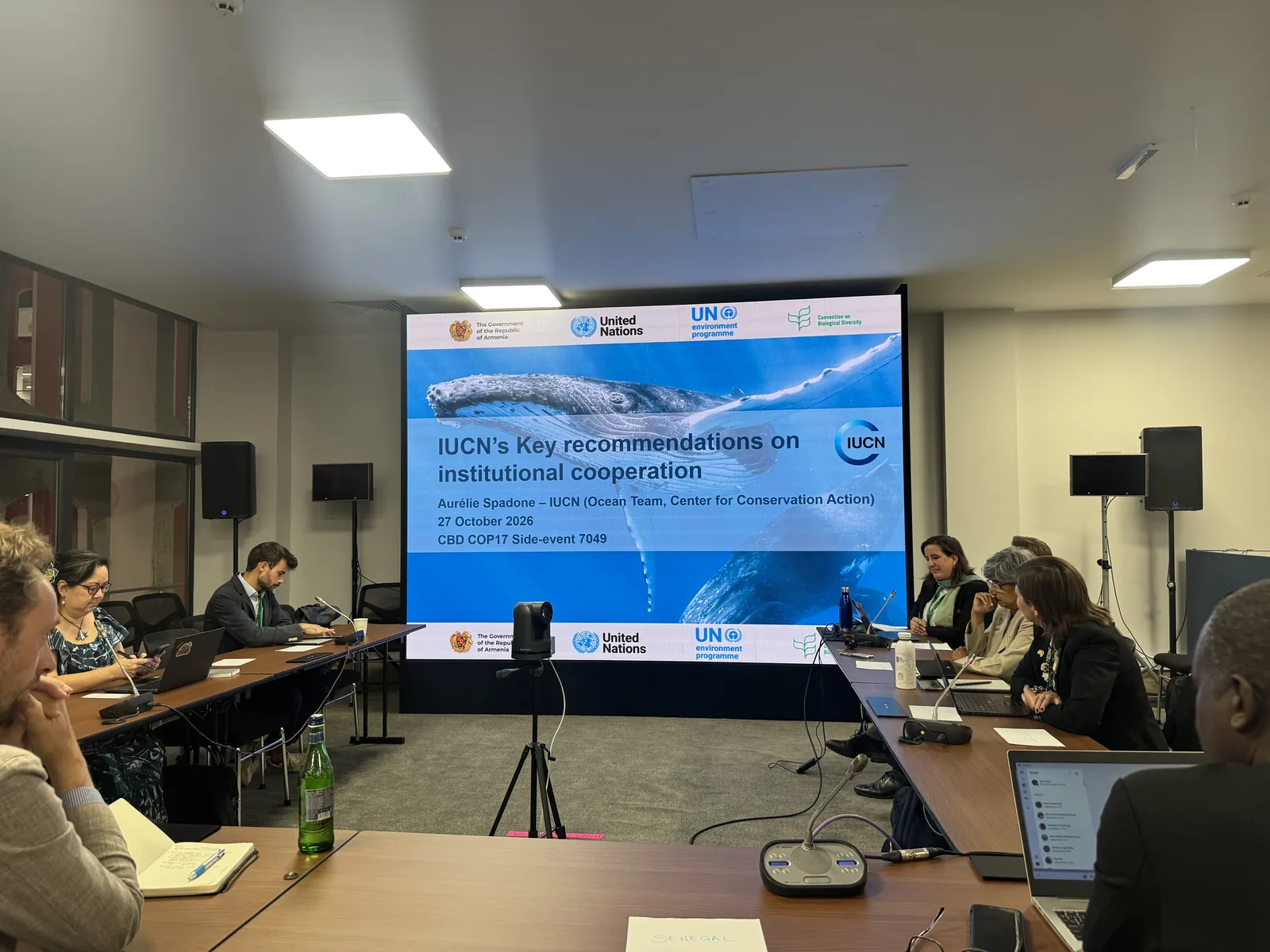
Among the first proposals for high seas marine protected areas (MPAs) are those being drafted in West Africa and Chile, and the side event argued that the hard work happens before a proposal reaches the United Nations. Cooperation between ministries, regional fisheries bodies, scientists and funders needs to start at the design stage, speakers said, because the Agreement's review process will test whether proposals are connected and manageable.
The session, "From COP17 to IMPAC6: Connected High Seas Marine Protected Area Networks", was a COP17 side event on 27 October 2026, 18:15–19:35 local time, in the Komitas room, Blue Zone, Block 2, 3rd floor, Yerevan.
It looked ahead to the sixth International Marine Protected Areas Congress (IMPAC6) in Dakar.
The gap is about area, and also about connection
Target 3 of the Kunming–Montreal Global Biodiversity Framework calls for at least 30% of coastal and marine areas to be effectively conserved and managed by 2030 through ecologically representative, well-connected and equitably governed systems of protected areas and other effective area-based conservation measures (OECMs). Protected Planet's November 2026 update, cited in the session, puts global marine coverage at 9.71% for protected areas and 9.99% including OECMs. At that baseline the gap to 30% is roughly 72 million km². That is an area figure. Target 3 also asks how sites are governed, connected and managed.
How the BBNJ process works
The IUCN presentation drew on a workshop supported by the French Biodiversity Agency (OFB) in Gland, Switzerland, on 27–29 January 2026, shortly after the Agreement entered into force on 17 January. It examined how the Agreement can work with existing legal instruments, frameworks and global, regional and sectoral bodies.
Under Part III of the Agreement, one or more Parties may submit a proposal for an area-based management tool, including an MPA. The Secretariat sends it to the Scientific and Technical Body for preliminary review. The formal process then includes consultation, scientific assessment and consideration by the Conference of the Parties (COP). IUCN stressed starting cooperation during proposal design, so counterparts understand each other's mandates and timelines and identify measures already in place.
Speakers said states need to coordinate positions across ministries, and regional and sectoral bodies need the capacity to engage. Several panellists named getting the Scientific and Technical Body operational as a priority. Its terms of reference and operating arrangements are on the agenda for the first BBNJ COP.
Two proposals taking shape
Nigeria described work towards a highly and fully protected high seas MPA in the Guinea–Canary Currents Convergence Zone, under a West Africa BBNJ Coordination Committee of Benin, Ghana, Guinea, Guinea-Bissau, Nigeria, Senegal and Sierra Leone. The intervention stressed shared science and participation by coastal communities, artisanal fishers and women in fish processing and trade. It also called for designing monitoring, control and surveillance from the start. Senegal presented IMPAC6's high-level segment as a chance to seek political, technical and financial support.
Chile's Ambassador Julio Cordano discussed work towards a high seas MPA covering the Salas y Gómez and Nazca ridges, documented under the CBD as an ecologically or biologically significant marine area. In September 2026, the Scientific Committee of the South Pacific Regional Fisheries Management Organisation (SPRFMO) recommended that its Commission maintain restrictions on certain trawling and limit other new bottom-contact fishing methods in the area. The session notes say this fisheries work can inform cooperation on the candidate MPA. Chile also leads the BBNJ First Movers initiative, a forum for countries developing proposals.
What pilots and funders are testing
The French Facility for Global Environment (FFEM) has committed €11.5 million to high seas projects in the Atlantic, Indian and Pacific oceans. The French Development Agency described support for preparatory work in the south-western Indian Ocean. The Living High Seas initiative, run by GIZ, the Global Ocean Biodiversity Initiative and IUCN, supports country-led proposals in Brazil, Chile, Ecuador, Indonesia, the Federated States of Micronesia and Senegal; its project period is April 2025 to March 2031.
The Pew Charitable Trusts discussed strengthening protection around South Africa's Prince Edward Islands and options for connecting areas across the Del Caño Rise towards France's Crozet Islands. Tara Ocean Foundation and Plankt'ECO presented a preliminary map of key ocean planktonic areas where plankton diversity, productivity and carbon export all score high, and named BBNJ COP1 or IMPAC6 as venues for sharing it.
In the Q&A, panellists discussed coordinating pilots that cover similar areas so findings reach governments preparing proposals. Closing remarks highlighted Senegal's community marine conservation; its 2026 Voluntary National Review reports MPA coverage of 4.9% in 2025. The transcript ends during closing remarks and records no formal decision.