Day 9 · 27 October 2026
Bridging fisheries and environment takes years: the Sustainable Ocean Initiative's country results are still arriving
Highlights
What happened: A COP17 side event reviewed how the Sustainable Ocean Initiative helps countries bring fisheries, environment and planning agencies together to apply the Global Biodiversity Framework at sea.
Why it matters: The examples from Senegal, Malaysia and the Philippines are all still at the stage of a fund being built, area descriptions awaiting review and a bill that had reached the Senate.
Senegal began building a trust fund for marine conservation in July 2026, and Malaysia hopes its proposed marine area descriptions will be considered in 2028. Neither is finished, which is the point of a side event on the Sustainable Ocean Initiative (SOI) at COP17 in Yerevan. Bridging sectors, speakers argued, takes sustained cooperation, because institutions need time to build trust and apply what they learn.
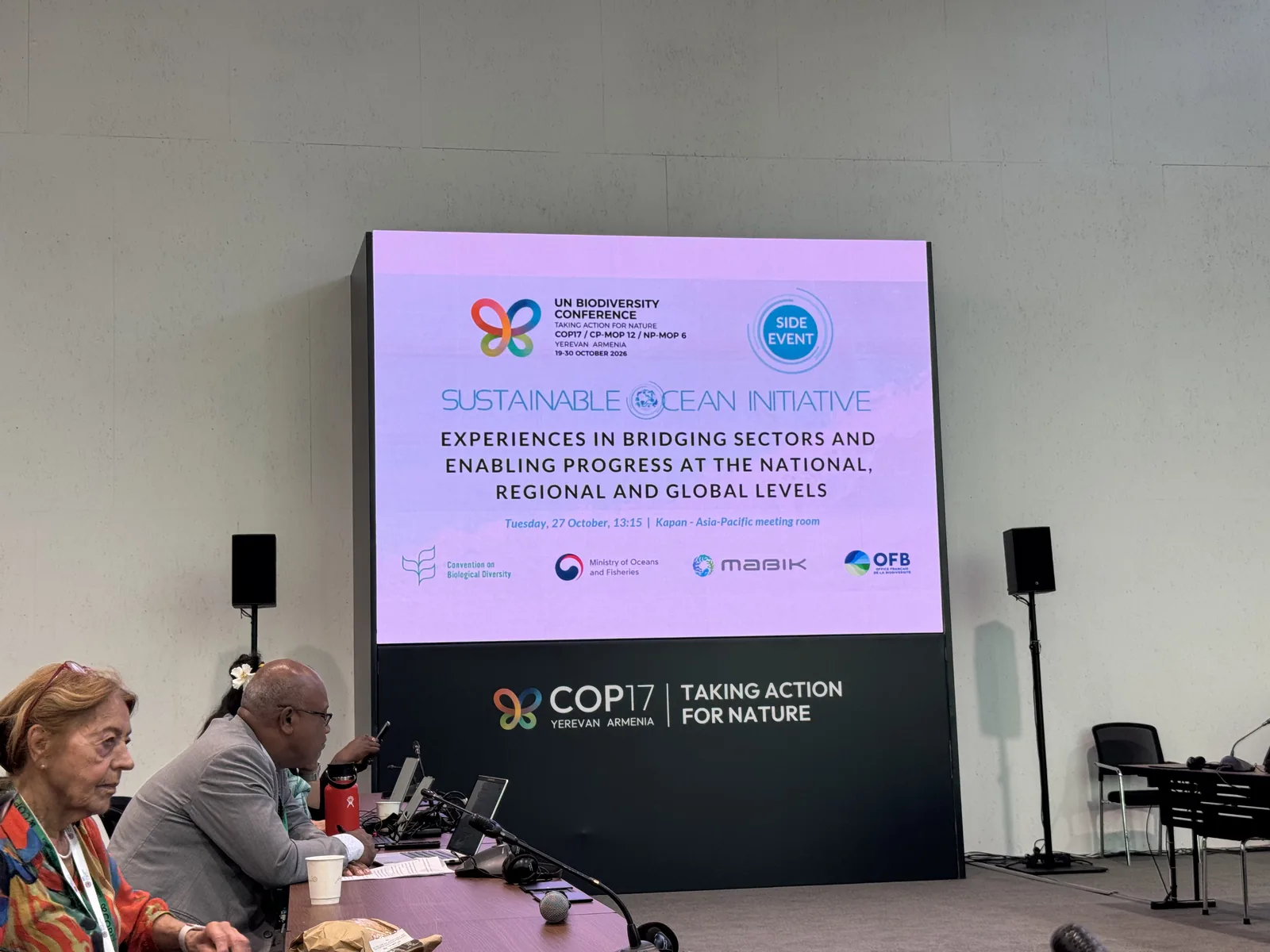
The session, "Sustainable Ocean Initiative: Experiences in Bridging Sectors and Enabling Progress at the National, Regional and Global Levels", was an official side event on Tuesday 27 October 2026, starting at 13:15 Yerevan time, in the Kapan Asia-Pacific Meeting Room. It was organised by the CBD Secretariat, Korea's Ministry of Oceans and Fisheries, the National Marine Biodiversity Institute of Korea and the French Biodiversity Agency (OFB).
A capacity-building initiative with long-term funding
SOI was established in 2010 on the margins of CBD COP10 in Nagoya. It brings together governments, technical experts, regional organisations and funding partners to strengthen capacity for marine and coastal biodiversity work. The CBD Secretariat described a recurring problem: fisheries and environment authorities, scientists and decision-makers need ways to work together. SOI addresses this through national workshops, regional exchanges and a Global Dialogue. The Republic of Korea renewed its agreement with the Secretariat on 28 April 2025, extending its financial support through 2030.
Senegal: a trust fund still being built
Senegal's representative outlined a trust fund meant to provide long-term finance for biodiversity, including marine protected areas (MPAs). Development began formally in July 2026, with support from Wetlands International and the French Development Agency. Possible revenue includes environmental compensation and private contributions. Legal structure, governance and fundraising are next steps.
Timelines differ. The session cited the first quarter of 2027 for putting the structure in place, while an official at the July launch gave September 2027 for the fund to be operational. After COP17, Wetlands International reported an initial US$5 million pledge from the Senegalese government towards the fund's capital.
Malaysia and the Philippines: evidence and planning
Malaysia's Department of Fisheries presented, in a pre-recorded talk, results of an SOI workshop held in Putrajaya on 5–7 August 2025. Participants discussed seven candidate areas and one revision under the CBD process for describing ecologically or biologically significant marine areas (EBSAs). EBSA descriptions give scientific information that authorities can use in marine spatial planning, fisheries management and decisions on MPAs and other effective area-based conservation measures (OECMs). The proposed revision would extend the Tioman Marine Park description to the Mersing archipelago, which has 62 islands and islets.
The presenter said Malaysia had sent material to the CBD Secretariat for an initial check and hoped for consideration in 2028. That is the presenter's expectation. As of 26 November 2026, the CBD's public list for the process showed no Malaysian entries.
The Philippines workshop, held in Manila on 4–6 March 2026, supported a national marine spatial planning framework. Marine spatial planning is a way of deciding where different ocean uses happen. The presenter described overlapping uses, fragmented responsibilities and data gaps, and named existing energy and fisheries plans as starting points. The notes record a link to proposed Blue Economy legislation, House Bill 6762, which includes marine spatial planning provisions. The House approved it on 16 December 2025, before the workshop, and sent it to the Senate the next day.
Regional and global links
The SOI Global Dialogue brings regional seas organisations and regional fishery bodies together with the CBD Secretariat, FAO and UNEP. Its fifth meeting took place in Seoul from 30 June to 3 July 2026 and addressed cooperation on the Kunming–Montreal framework and the High Seas Treaty (the BBNJ Agreement).
A Pacific presenter described how regional organisations support countries under the 2050 Strategy for the Blue Pacific Continent, naming limited and fragmented finance, monitoring gaps and overlapping mandates. They called for sharing data, drawing on Indigenous and traditional knowledge and involving local communities. The area cited covers the combined exclusive economic zones of 22 Pacific Island countries and territories, more than 27 million km². OFB and a regional presenter also highlighted a February 2025 workshop in Dakar on area-based conservation under Target 3.
Proposals, not decisions
Looking ahead, the Korean representative discussed a proposed 2027 workshop on mobilising finance for the framework and bringing SOI lessons to the first BBNJ COP, on 11–22 January 2027 in New York. Opening remarks encouraged SOI partners to take part together in the next UN Ocean Conference, in Busan in June 2028. These were forward-looking proposals, not decisions. The session also pointed to the sixth International Marine Protected Areas Congress, in Dakar on 22–27 March 2027, the first in Africa.